StudyNotes
SMART STUDY PORTAL

Learn by Subject & Unit

Beautifully organized notes, unit-wise navigation and image-supported explanations.

01

Browse Subjects

02

Units

03

Latest Notes

20 Notes
Computer FundamentalsUnit 01

Introduction to Computer Fundamentals

Overview of computer systems.

Read full note
Computer fundamentals cover hardware, software, data processing, storage and input/output devices. A computer accepts input, processes it using instructions, stores information and produces output.
Data StructuresUnit 01

Stack and Queue

Two important linear data structures.

Read full note
A stack follows LIFO: Last In, First Out. A queue follows FIFO: First In, First Out. Typical stack operations are push and pop, while queue operations are enqueue and dequeue.
CSIT- 6th E-CommerceUnit 01

1.1. E-commerce

Read full note
E-commerce is the process of buying and selling of information, products and services using electronic medium usually over computer network. It is the transfer of traditional commerce to the computer network or internet. In e-commerce we use electronic medium to perform commercial activities such as order, payment, and delivery.
CSIT- 6th E-CommerceUnit 01

2. E-Business:

Basically, E-commerce and E-business are similar concepts. Some people view these things differently. E-commerce is a narrow concept which includes only buying and selling of products and services i.e., shopping by using electronic medium.

Read full note
E-business is a broad concept. E-business includes more activities than just buying and selling. E-business involves:
• Transactions between business partners.
• Customer service
• Collaboration.
• Internal processes to support buying, selling, planning etc.

Hence, E-business is larger than E-commerce, i.e., E-business includes E-commerce + other activities related to business.

Features / Benefits of E-commerce

i) Ubiquity:
E-commerce is widespread, that is, it is available everywhere always. It sets free market from being restricted to a physical space and makes it possible to shop from computer and other devices. The result is called a market place.

ii) Global Reach:
E-commerce technologies enable a business to easily reach across geographic boundaries around the earth. Globally, companies are acquiring greater profits and business results by expanding their business with e-commerce solutions.

iii) Universal Standards:
Universal Standards are standards shared by all the nations around world. These are technical standards of Internet for conducting e-commerce. It gives all the ability to connect at the same level and it provides network externalities that will benefit everyone. Universal technical standards lower entry costs and minimal search costs.

iv) Interactivity:
E-commerce technologies permits two-way communication between customer and sellers which makes it interactive. It proves as significant feature e-commerce technology over the commercial traditional technologies of the 20th century.

v) Information Density:
Information density means total amount and quality of information available over Internet to all market buyers and sellers. Information density offers better quality information to consumers and merchants.

vi) Richness:
Richness refers to the complexity and content of a message. Richness means all commercial activity and experience conducted through a variety of messages. For example, text, pictures, videos, sound, links, SMS etc.
CSIT- 6th E-CommerceUnit 01

3. History of E-commerce

3. History of E-commerce

Read full note
The history of e-commerce started 40 years ago and, to this day, continues to grow with new technologies, innovations, and thousands of businesses entering the online market each year. Electronic Data Interchange (EDI) and teleshopping in the 1970s paved the way for the modern-day commerce store. The history of e-commerce is closely intertwined with the history of the Internet. Online shopping only became possible when the Internet was opened to the public in 1991. Amazon.com was one of the first e-commerce sites in the US to start selling products online, and thousands of businesses have followed since.

E-commerce Framework (5 Pillars of E-commerce)
Applications
• Supply chain management
• Video on demand
• Remote banking
• Online marketing and advertising
• Home shopping
Framework Layers
1. Common Business Services Infrastructure
o Security
o Authentication
o Electronic payment
2. Messaging and Information Distribution Infrastructure
3. Multimedia Content and Network Publishing Infrastructure
4. Information Superhighway Infrastructure
o Telecommunications (Telecom)
o Internet
Supporting Pillars
Left Pillar
• Public policy
• Legal and privacy issues
Right Pillar
• Technical standards for:
o Electronic documents
o Multimedia
o Network protocols
CSIT- 6th E-CommerceUnit 01

4

Types of E-commerce

Read full note
The major types of e-commerce include:

1. Business-to-Consumer (B2C) E-commerce
It is the most commonly discussed type of e-commerce in which online businesses attempt to reach individual consumers. In B2C, consumers buy goods and services from businesses.
Example: A customer buys a computer online directly from Dell (dell.com).

2. Business-to-Business (B2B) E-commerce
In this type of e-commerce, both parties are businesses.
Example: A motorcycle manufacturing company, Hero, buys tyres from MRF company. B2B e-commerce has significant growth potential, and its market size is potentially huge.

3. Consumer-to-Consumer (C2C) E-commerce
In this type of e-commerce, both parties are consumers.
Example: There are many auction websites where consumers can sell products to other consumers. One example is OLX, where consumers can put their items up for sale and another consumer buys them.

4. Consumer-to-Business (C2B) E-commerce
In this type of e-commerce, a consumer sells products and services to a business.
Example: A person sells old household items to a company that collects and reuses them. Similarly, people sell old iron and plastic to businesses that manufacture new products from recycled materials.
CSIT- 6th E-CommerceUnit 01

5. Other Types of E-commerce

Other Types of E-commerce

Read full note
1. Mobile E-commerce (M-Commerce)
Mobile e-commerce, or M-commerce, refers to the use of mobile devices to conduct online transactions. It involves the use of cellular and wireless networks to connect laptops, smartphones (such as iPhone and Android devices), and tablets (such as iPad) to the Internet.
Once connected, mobile consumers can perform various transactions, including:
• Stock trading
• In-store price comparisons
• Mobile banking
• Travel reservations
• And many more

2. Social E-commerce
Social e-commerce is e-commerce that is enabled by social networks and online social relationships. It is sometimes referred to as Facebook commerce, but it is actually a much broader phenomenon that extends beyond Facebook alone.

3. Local E-Commerce
Local e-commerce, as its name suggests, is a form of e-commerce that is focused on engaging consumers based on his or her current geographic location. Local merchants use a variety of online marketing techniques to drive consumers to their stores. Local e-commerce is the third prong of the social, mobile, and local (SoLoMo) trend and is expected to grow rapidly.

4. U-Commerce (Ubiquitous Commerce)
Ubiquitous Commerce, also known as U-Commerce, refers to a variety of goods and/or services. Sometimes, it is used to refer to the wireless, continuous communication and exchange of data and information between and among retailers, customers, and systems regardless of location, devices used, or time of day.
CSIT- 6th E-CommerceUnit 01

6

Challenges in E-Commerce

Read full note
• Online Identity Verification Problem: People may enter wrong information.
• Competitor Analysis: Many vendors offer the same product. We must know the market.
• Maintaining Customer Loyalty: Keep existing customers and attract new ones.
• Product Return and Refund Policy
• Shipping Cost
• Data Security
• Switching to M-Commerce and IoT-Commerce
• Trust
CSIT- 6th E-CommerceUnit 01

7

Status of E-commerce in Nepal

Read full note
Currently in Nepal, there are dozens of ISPs with millions of Internet users. Initially, e-commerce activities were mainly concentrated in Kathmandu Valley and some major cities. E-commerce was introduced in Nepal with an aim of letting Nepalese residing abroad send gifts to their families, friends, and relatives living here. The shift from physical stores to virtual ones began in the late 1990s.
Nowadays, with the increase of Internet availability and the number of mobile users in rural areas, there is an increase in online activities. Today there are many e-commerce websites that are providing e-commerce services, e.g., Daraz, HamroBazar, SastoDeal, Shopmandu, etc.
CSIT- 6th E-CommerceUnit 01

8

Overview of Electronic Transaction Act of Nepal

Read full note
The first attempt by Nepal to formally legalize and regulate electronic transactions was enacted in 2063 BS (2008 AD). It defines, regulates, and recognizes electronic records and digital signatures. It defines the process of dispatch, receipt, and acknowledgement of electronic records. It has the provision of a few regulating bodies and their functions, rights, and duties such as:

• Office of Certificate Control (OCC)
• Certification Agencies (CA)
• Subscriber

It has provisions relating to the use of digital signatures and certificates. It also has provisions relating to computer-related crimes and punishments. The Act further defines a few documents for which this Act is not applicable.
CSIT- 6th E-CommerceUnit 02

Introduction:

Read full note
A business model is a set of planned activities designed to result in a profit in a marketplace. The business model spells out how a company makes money by specifying where it is positioned in the value chain. An e-commerce business model aims to use and hold the unique qualities of the Internet, the Web, and the mobile platform.
CSIT- 6th E-CommerceUnit 02

Elements of a business model:

Whether it is traditional commerce or e-commerce, a successful business model must address following key elements:

Read full note
1) Value proposition:
It defines how a company's product or service fulfills the needs of customers. From the customer point of view, successful e-commerce value propositions include personalization and customization of product offerings, reduction of production search costs, and facilitation of transactions by managing product delivery.
Example: buying a book in traditional commerce vs. Amazon.

2) Revenue Model:
A firm's revenue model describes how the firm will earn revenue, generate profits, and produce a superior return on invested capital. Profits alone are not sufficient to make a company "successful"; also a firm must produce returns greater than alternative investments to be successful.

3) Market Opportunity:
The term market opportunity refers to the company's intended marketspace and the overall potential financial opportunities available to the firm in that marketspace. It is defined by the revenue potential in each of the smaller market where we hope to compete.

4) Competitive Environment:
A firm's competitive environment refers to the other companies selling similar products and operating in the same marketspace. Firms typically have both direct and indirect competitors. Direct competitors are companies that sell products and services that are very similar and into the same market segment. Indirect competitors are companies that may be in different industries but still compete indirectly because their products can substitute for one another.

5) Competitive advantage:
Competitive advantage is achieved by a firm when it can produce a superior product and/or bring the product to market at a lower price than most or all of its competitors.

6) Market Strategy:
Any business concept fails if it is not properly marketed to the potential customers. Everything we do to promote our company's products and services to potential customers is known as marketing.

7) Organizational development:
It is the plan that describes how the company will organize the work that needs to be accomplished. Typically work is divided into functional departments such as, production, shipping, marketing, customer support, and finance.

8) Management Team:
A strong management team gives a model instant credibility to outside investors, immediate market-specific knowledge, and experience in implementing business plans. A strong management team may not be able to rescue a weak business model, but the team should be able to change the model and redefine the business as it becomes necessary.
CSIT- 6th E-CommerceUnit 02

Types of Revenue Models:

Read full note
1) Advertising model:
In this model, a company that offers content, services, and/or products also provides a forum for advertisements and receives fees from advertisers. Google, for instance, derives a significant amount of revenue from display and video advertising.

2) Subscription model:
In this model, a company that offers content or services charges a subscription fee for access to some or all of its offerings. Netflix is an example which takes subscription fee for streaming videos.

3) Transaction fee model:
In this model, a company receives a fee for enabling or executing a transaction. For example, eBay provides an auction marketspace and receives a small transaction fee from seller if the sale is successful in selling the item.

4) Sales model:
In this model, a company sells goods, information, or services. Amazon is its example.

5) Affiliate model:
In this model, companies to an "affiliate" receive a referral fee or percentage of the revenue from any resulting sales.
CSIT- 6th E-CommerceUnit 02

B2C Business Models:

Read full note
1) E-tailer:
E-tailers are the online retail store. They come in all sizes, from giant Amazon to tiny local stores that have Web sites. Every Internet and Smartphone user is a potential customer. Customers can place an order and pay electronically. It is product-based, with customers paying for the purchase of particular item.

2) Community Provider:
Community providers create an online environment where people with similar interests can buy and sell goods; share interests, photos, videos; communicate with like-minded people etc. Facebook, LinkedIn, Twitter etc. social networks all offer users community-building tools and services.

3) Content Provider
Content providers distribute information content, such as digital video, music, photos, text, and artwork. Content providers can make money via a variety of different revenue models, including advertising, subscription fees, and sales of digital goods. For instance, in the case of Apple Music, a monthly subscription fee provides users with access to millions of music tracks.

4) Portal
Portals offer users powerful search tools as well as an integrated package of content and services, such as news, e-mail, instant messaging, shopping, video streaming, and more, all in one place. Yahoo, MSN are its examples. Portals generate revenue from advertising.

5) Transaction Broker
Companies that process transactions for consumers, normally handled in person, by phone, or by mail, are transaction brokers. Transaction brokers make money each time a transaction occurs.
Examples: Online stock brokers, Air ticket booking.

6) Market Creator
Market creators build a digital environment in which buyers and sellers can meet, display and search for products and services, and establish prices. Market creators make money by either charging a percentage of every transaction made or by charging merchants for access to the market.
Example: eBay.

7) Service Provider
Service providers offer services online instead of products. They generate revenue by charging fees or monthly subscriptions, or through advertising, etc.
Examples: Online medical bill management, travel recommendation services, etc.
CSIT- 6th E-CommerceUnit 02

B2B Business Models

Read full note
1) Network Marketplaces

a) E-distributor
Companies that supply products and services directly to individual businesses are e-distributors. E-distributors are owned by one company seeking to serve many customers. With e-distributors, the more products and services a company makes available on its site, the more attractive that site is to potential customers.

b) E-Procurement
Procurement is the process of finding and agreeing to terms, and acquiring goods or services. It helps buyers decide the market value of the product or service being purchased by a company. Right prices, timely delivery, right quality, and right quantity are the major components of procurement.

c) Exchange Market
An exchange market is an independent digital marketplace where hundreds of suppliers meet a smaller number of very large commercial purchasers. They focus on the exchange of direct inputs to production and short-term contracts or spot purchasing.

d) Industry Consortium
These are industry-owned vertical marketplaces that serve specific industries, such as the automobile, aerospace, and chemical industries.

2) Private Industrial Networks

A private industrial network is a digital network designed to coordinate the flow of communications among firms engaged in business together. The network is owned by a single large purchasing firm. It constitutes about 75% of all B2B expenditures.
For instance: Walmart operates one of the largest Private industrial networks in the world for its suppliers, who on a daily basis use Walmart's network to monitor the sales of their goods, the status of shipments, and the actual inventory level of their goods.
CSIT- 6th E-CommerceUnit 02

Electronic Data Interchange (EDI)

Read full note
EDI is a communications standard for sharing business documents and settlement information among business partners or companies. It is a set of standards for structuring information that is to be electronically exchanged between and within businesses, organizations, government entities, and other groups, without human intervention. EDI was developed to reduce the costs, delays, and errors present in the manual exchange of documents such as purchase orders, shipping documents, price lists, payments, and customer data.
Companies use EDI systems for exchanging business information automatically by computer systems as transactions without paper, and hence minimizes human intervention. EDI is generally used for B2B transactions.
Common EDI documents include:
• Purchase order
• Invoice
• Shipping request
• Acknowledgement
CSIT- 6th E-CommerceUnit 02

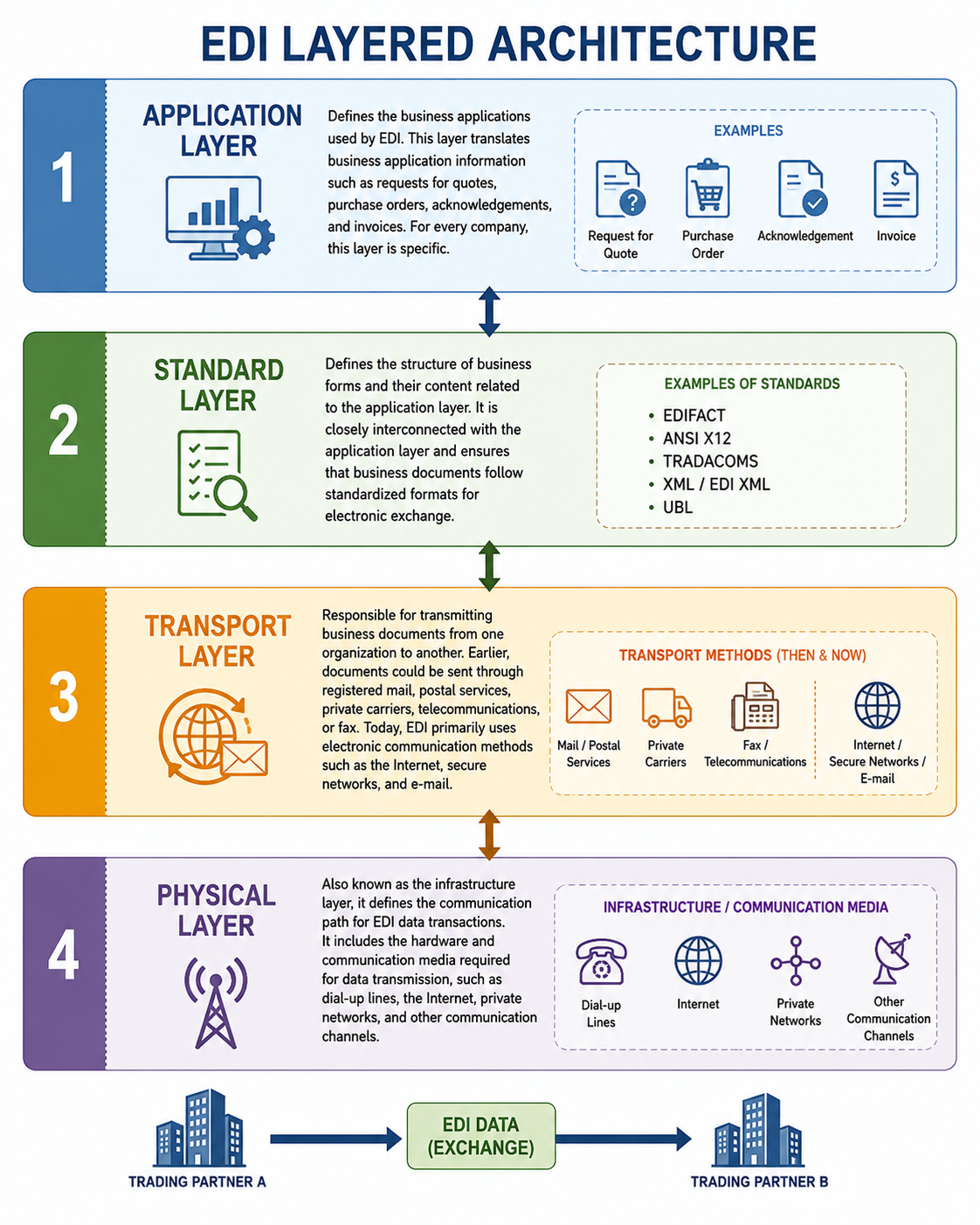
EDI Layered Architecture

Note image
Read full note
EDI layered architecture includes 4 layers:

1) Application Layer
The first layer of EDI is the Application Layer, which defines the business applications that are used by EDI. This layer of EDI translates business application information (such as requests for quotes, purchase orders, acknowledgements, and invoices). For every company, this layer is specific.

2) Standard Layer:
This layer of the EDI architecture defines the structure of business forms and their content, which are related to the application layer. It is closely interconnected with the application layer and ensures that business documents follow standardized formats for electronic exchange.

3) Transport Layer:
The transport layer of EDI is responsible for transmitting business documents from one organization to another. Earlier, documents could be sent through registered mail, postal services, private carriers, telecommunications, or fax. Today, EDI primarily uses electronic communication methods such as the Internet, secure networks, and e-mail for faster and more reliable data transmission.

4) Physical Layer:
The physical layer of EDI, also known as the infrastructure layer, defines the communication path for EDI data transactions. It includes the hardware and communication media required for data transmission, such as dial-up lines, the Internet, private networks, and other communication channels.
CSIT- 6th E-CommerceUnit 02

E-Commerce and Industry Value Chain

Read full note
A value chain is an interconnected set of value-adding activities involved in transforming raw materials into finished products and services. By reducing the cost of information and improving communication, e-commerce enables each participant in the industry value chain such as suppliers, manufacturers, distributors, transporters, retailers, and customers to improve their competitive position by lowering costs, increasing efficiency, and/or enhancing value.

Benefits of E-Commerce in the Industry Value Chain

• Manufacturers can reduce procurement costs by developing Internet-based Business-to-Business (B2B) exchanges with their suppliers.
• Distributors can implement highly efficient inventory management systems, reducing storage and operational costs.
• Customers can easily compare products and search for the best quality, fastest delivery, and lowest prices before making purchasing decisions.
CSIT- 6th E-CommerceUnit 02

Firm Value Chains

Read full note
The set of activities a firm engages in to create final products from raw inputs is called the firm value chain. The concept of the value chain can be used to analyze a single firm's operational efficiency as well. Each step in the production process adds value to the final product.

Every firm can be characterized by a set of value-adding primary and secondary activities performed by different actors within the firm. A simple firm value chain consists of five primary value-adding activities, which are:

• Inbound Logistics
• Operations
• Outbound Logistics
• Sales and Marketing
• After-Sales Service
CSIT- 6th E-CommerceUnit 02

Firm Value Webs

Read full note
A value web is a networked business ecosystem that uses e-commerce technology to coordinate the value chains of business partners within an industry or, at a broader level, to coordinate the value chains of a group of firms. E-commerce creates new opportunities for firms to cooperate and build a value web.

Firms use the Internet to develop close relationships with their logistics partners. For example, Amazon relies on UPS tracking systems to provide customers with online package tracking, and it also relies on the U.S. Postal Service (USPS) to insert packages directly into the mail stream.